Dharma in the Yoga Sutras Workshop: A personal reflection
By Fiona Hardie
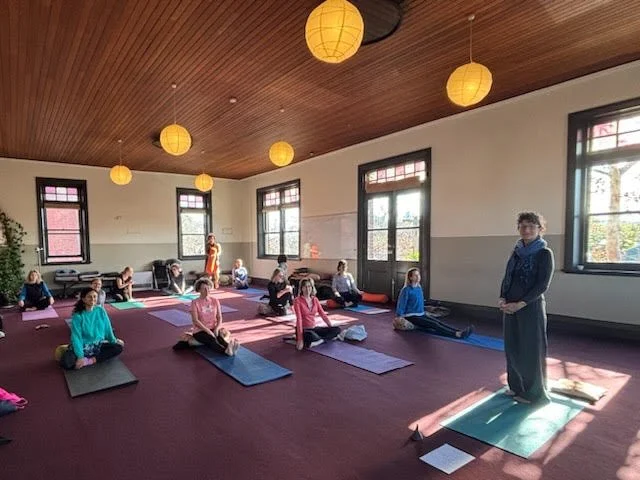
On the last Sunday in July, I joined a group of Agama and visiting NZ teachers, as well as regular Sunday morning class students for some continuing education on Yoga Sutra study.
The Yoga Sutras are a collection of 196 sutras or aphorisms which set out the philosophy of yoga. There are very few words in each sutra, but they are written in such a way as to make them bursting with meaning, interpretations of which are explored all around the world in commentaries and through workshops and discussion just like ours!
On this particular Sunday the workshop was led by Valerie Fimat-Faneco, a senior teacher in the tradition of Krishnamacharya, who has lived overseas most of her adult life, but has recently settled in Perth with her Australian husband. We are now to be able to attend her workshops in WA, and invite her to teach at Agama when she visits her children who study here.
The theme was Dharma in the Yoga Sutras. Dharma is a word that has a lot of different meanings and holds significant importance when in reflection about how we live our lives. In the Yoga Sutras it is only mentioned three times; but Valerie posits that its meaning is embedded throughout the Sutras, and therefore perhaps a more important concept in yoga philosophy that we might have thought.
She contends that there are three qualities that are the essence of dharma, and that every single sutra has one or more of these attributes. They are:
Commitment (samkalpa)
Understanding (jnana) and
Action (karman)
It was fascinating to reflect on this. For example, the first two limbs of Patanjali’s eight limbs – the Yamas (social behaviours eg do no harm) and Nyamas (personal practices, eg self reflection) – are all dharma in the sense of Action - how we should act. Other sutras require commitment or intention, for example to persist or to follow a path and others, understanding - of how things are related, the causes of suffering, and so on.
Even for students of yoga who aren't familiar with the Sutras, I always find that yoga philosophy is accessible for anyone simply curious about ways of making sense of the world and our place in it.

Suffice to say, the discussion was robust, and Valerie layered the day with physical and breath practices, meditation, and chanting so we embodied these ideas beautifully. For example the asana practice was grounding us in intention - holding the feet in our forward folds, staying there, and paying attention to the length and quality of our exhale.
Through the chanting I was reminded of how it feels to chant the Yoga Sutras themselves and this connects us to the very heart of yoga and to each other – the short and punchy structure of the sutras, the immersive sound of group chanting and the resonance of that sound inside you when you make it yourself is incredibly grounding.
All in all throughout the day I was drawn back to the Sutras as the essence of yoga, and reminded that yoga is a way not just to practice but to reflect on and aim to live a life that is thoughtful, intentional and multi-dimensional.